Congress was days away from a potential federal government shutdown. As lawmakers raced toward the funding deadline, uncertainty surrounding federal spending and clean energy investments dominated the news cycle. To prevent organizational gridlock and keep supporters engaged before critical funding deadlines, the NRDC Action Fund needed an agile, rapid-response communications apparatus that could match the pace of Capitol Hill.
I led the development of the multi-channel strategy, scenario frameworks, and stakeholder pipelines required to deploy highly accurate, real-time mobilization assets that evolved seamlessly alongside breaking news.
My Role: Rapid-response campaign planning & operations, cross-channel copywriting (email, SMS, landing pages, constituent call scripts), multi-stakeholder approval coordination, and scenario-based content mapping.
The Challenge
How do you produce accurate, timely digital campaigns when the news changes by the hour, but standard organizational approvals take up to 48 hours per reviewer?
The communications challenge extended beyond being the first to hit send. Legislative proposals changed daily, media coverage evolved by the hour, and every update required balancing strict policy accuracy with clear, accessible messaging. To launch a single piece of rapid-response content, the workflow typically required navigating a gauntlet of five separate high-level stakeholders including two policy attorneys, legislative experts, and the President of the Action Fund.
Supporters needed to understand not only what Congress was debating in real time, but how those fast-moving decisions directly impacted clean energy investments and what actions they could take before the funding deadline. Success depended on anticipating multiple legislative scenarios, building adaptive communications frameworks in advance, and systematically compressing that multi-stakeholder approval loop so the campaign could pivot at the speed of the news cycle.
The Approach
I architected a coordinated, multi-stage rapid-response campaign that guided supporters from initial awareness to increasingly higher-impact actions as the funding deadline approached. As congressional negotiations evolved, communications were continuously updated to remain accurate while escalating supporter engagement from digital advocacy to direct constituent phone calls.
Behind the scenes, I designed a matrixed approval framework that pre-aligned legal, policy, and executive stakeholders on shifting scenarios, mitigating bureaucratic bottlenecks before the deadline so the campaign could adapt quickly as negotiations changed.
7 DAYS OUT: Settining the Stakes
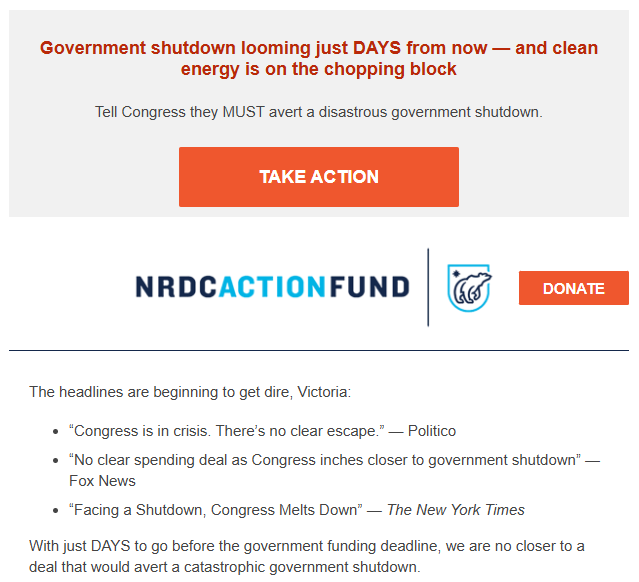
A shutdown seems imminent as disagreements escalated around proposed funding bills threatened clean-energy investments and environmental protections. The communications challenge was translating a rapidly evolving legislative debate into clear consequences while giving supporters an immediate action they could take.
Campaign response: Developed the initial advocacy email and congressional petition urging supporters to oppose the shutdown and defend Inflation Reduction Act investments.
4 DAYS OUT: Escalating the Ask
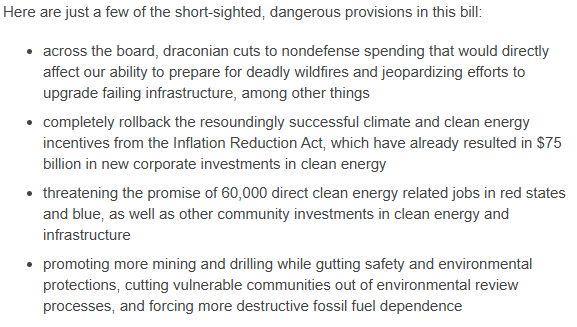
To maintain momentum, my team distilled hundreds of pages of complex, late-night legislative text into concise, audience-focused talking points almost as quickly as new information became available. Supporters who had already contacted Congress were encouraged to call their elected officials directly, while new audiences received updated messaging reflecting the latest legislative developments.
As legislative negotiations continued to evolve, complex policy language had to be translated into concise, audience-focused communications almost as quickly as new information became available.
Campaign response: Finalized follow-up emails, congressional call pages, constituent call scripts, fundraising communications, and updated messaging as negotiations changed.
1 DAY OUT: Final Cross-Channel Sprint
With the funding deadline imminent, every communication emphasized urgency and immediate action. Short-form messaging re-engaged supporters across channels while reinforcing the campaign's final advocacy asks.
Campaign response: Extended the campaign through SMS, social sharing, and final supporter outreach to maximize participation before the deadline.
.jpg)
FUNDING DEADLINE
By the time Congress reached the funding deadline, supporters had been guided through an integrated advocacy journey spanning email, petitions, fundraising, constituent phone calls, SMS, and social engagement. Throughout the campaign, communications evolved alongside breaking news and legislative negotiations, ensuring supporters always understood both what was happening and how they could respond.
As the government shutdown became reality, the campaign shifted from preparing supporters for the deadline to helping them understand ongoing developments. Building on the rapid-response framework already in place, I continued adapting messaging and audience segmentation strategies to keep supporters informed and engaged throughout the shutdown. Once the government reopened, I wrote a thank-you message that closed the campaign loop, helping supporters understand the impact of their advocacy during a critical moment.
The Results
Rapid response campaigns are about more than speed. They require disciplined planning, clear decision-making, and coordinated execution across multiple channels. By establishing scenario-based frameworks prior to the crisis, we replaced reactive panic with proactive execution. This operational agility eliminated standard 24-to-48-hour content approval delays per reviewer, compressing a complex, six-layerpolicy, legal, and executive review pipeline down to under 60 minutes.
The campaign demonstrated how thoughtful preparation can enable organizations to communicate with both urgency and accuracy during fast-moving policy debates.
"This is the moment your action matters most. Thank you for fighting with us."



.jpg)
